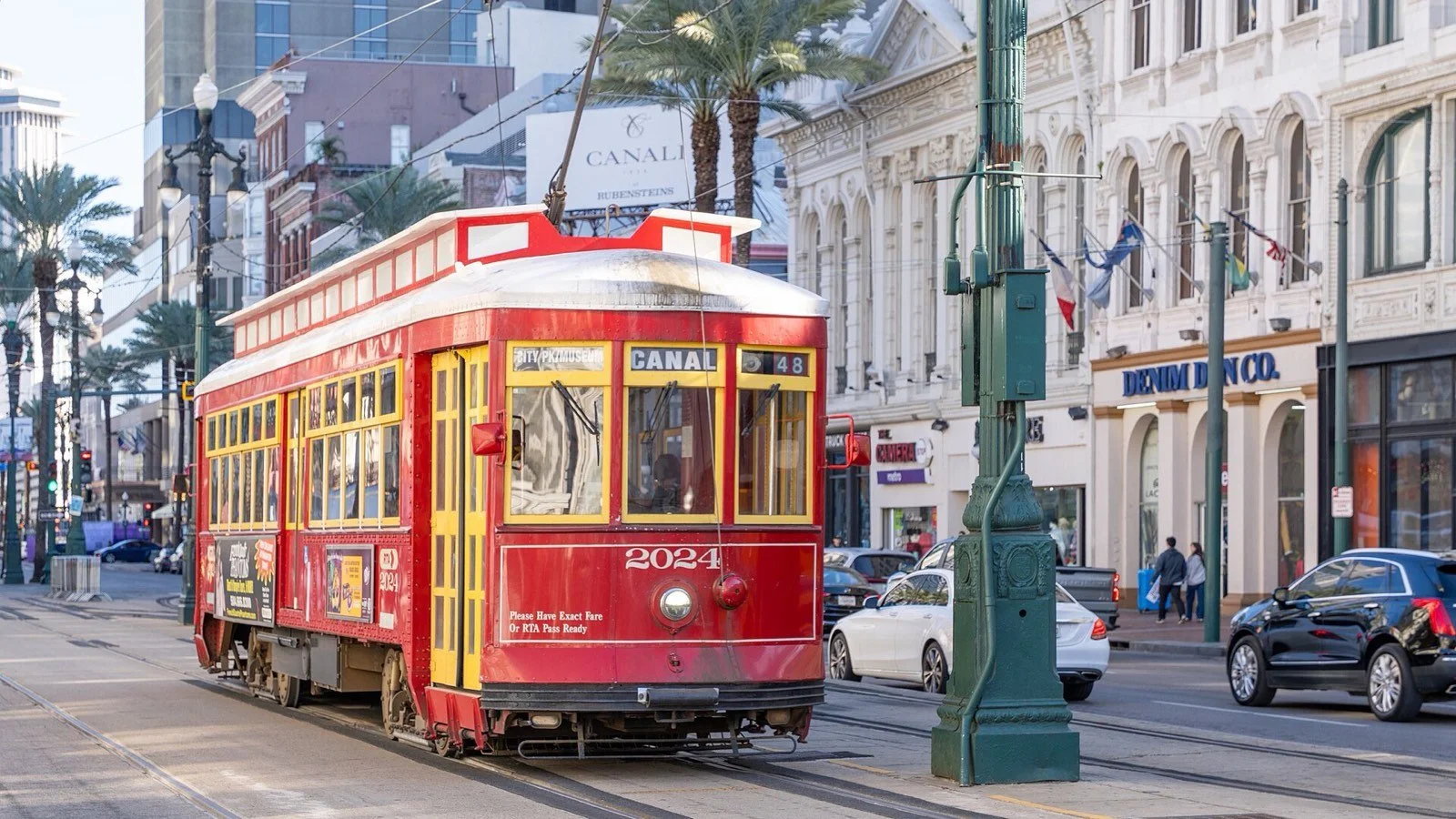
A red streetcar on Canal Street in New Orleans. Photo: Ajay Suresh.
Canal Street New Orleans is a wide, three-and-a-half-mile boulevard that marks the edge of the French Quarter, and it is also the city's old entertainment street, with historic theaters, a returning streetcar and the footprints of grand department stores. It is a street best understood on foot, one block at a time.
We are on the corner of Roosevelt Way and Canal Street, so this is our neighborhood. This guide tells its story: where the name came from, what the neutral ground is, which theaters still light up the sidewalk, and how to spend a day here. Dates and numbers come from the sources named in each section.
Why is it called Canal Street?
Canal Street takes its name from a canal that was planned along the line between the old French Quarter and the newer American sector, according to Wikipedia's article on the street. The canal was never built, and the street that took its place kept the name. That article is not fully consistent on this point, so treat the story as the standard explanation, not a proven record.
The street matters because of what it divided. The French Quarter, called the Vieux Carré, was the colonial Creole city. After the Louisiana Purchase in 1803, Americans settled upriver, in what is now the Central Business District. Canal Street became the seam between the two.
- Length: about 3.6 miles, from the river to the cemeteries near City Park Avenue.
- Width: 171 feet, per the article. It has been called America's widest main street, a claim the article hedges.
- Layout: three lanes of traffic each way, with the streetcar tracks down the middle.
What is the neutral ground on Canal Street?
The neutral ground is the grassy or paved median down the center of the street, and in New Orleans the word is used for any street's median. Wikipedia says the name on Canal Street acknowledged the cultural divide between the two sides of the city, and it gives no other origin.
You will hear the term constantly in New Orleans. Parade-goers claim a spot on it, and the streetcars run along it. The legend that the name began because neither group would cross the street is a popular tale. The sources we read do not confirm it, so we pass it along as legend only.
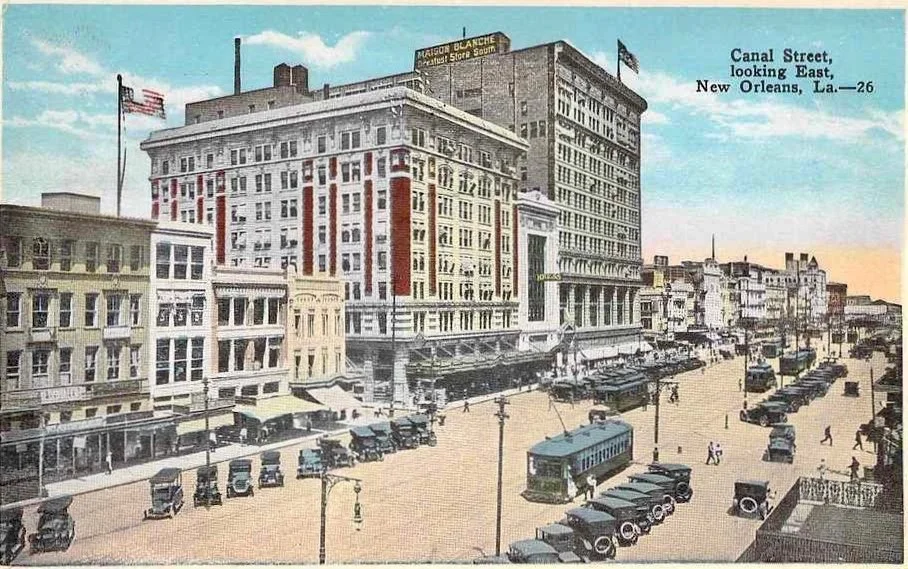
Canal Street looking east on a 1920s-era postcard, with the Maison Blanche sign atop the tallest building.
What happened to Canal Street's department stores?
For more than a century, Canal Street was the main shopping district of Greater New Orleans. Wikipedia names Maison Blanche, D. H. Holmes, Godchaux's, Gus Mayer, Labiche's, Kreeger's and Krauss among its department stores. Retail began to fade in the late 1960s and took further blows in the 1980s.
Two of the grand buildings found new lives. The former D. H. Holmes store and the former Maison Blanche store are both now hotels, according to the same article, and both sit on the French Quarter side of the street. The article does not give opening or closing years for the stores, so we have not either.
That is the pattern across the street. Retail faded, but the large downtown buildings stayed, and many were reused for hotels, venues and attractions. Walking Canal Street today means reading a layered city: marquees, cornices and old signage above new storefronts.
Which historic theaters can you still visit on Canal Street?
Three theaters carry the street's entertainment history: the Saenger Theatre at 1111 Canal Street, the Joy Theater at 1200 Canal Street, and the Orpheum, a short distance away on our own street. All three closed or were damaged at some point, and all three have been restored. Wikipedia describes each of them below.
- Saenger Theatre: opened February 4, 1927, designed by Emile Weil in an atmospheric style with a ceiling of lights shaped like constellations. After Hurricane Katrina, a restoration reopened it on September 27, 2013. It seats about 2,600 and hosts touring Broadway shows and concerts.
- Joy Theater: opened February 7, 1947, and closed in 2003 as multiplexes drew its audience away. It reopened in December 2011 as a venue for live music, stand-up comedy and events, with its art deco marquee restored.
- Orpheum Theater: designed by G. Albert Lansburgh, opened for vaudeville in 1921, and reopened in August 2015 after a restoration. The Louisiana Philharmonic Orchestra is its anchor tenant.
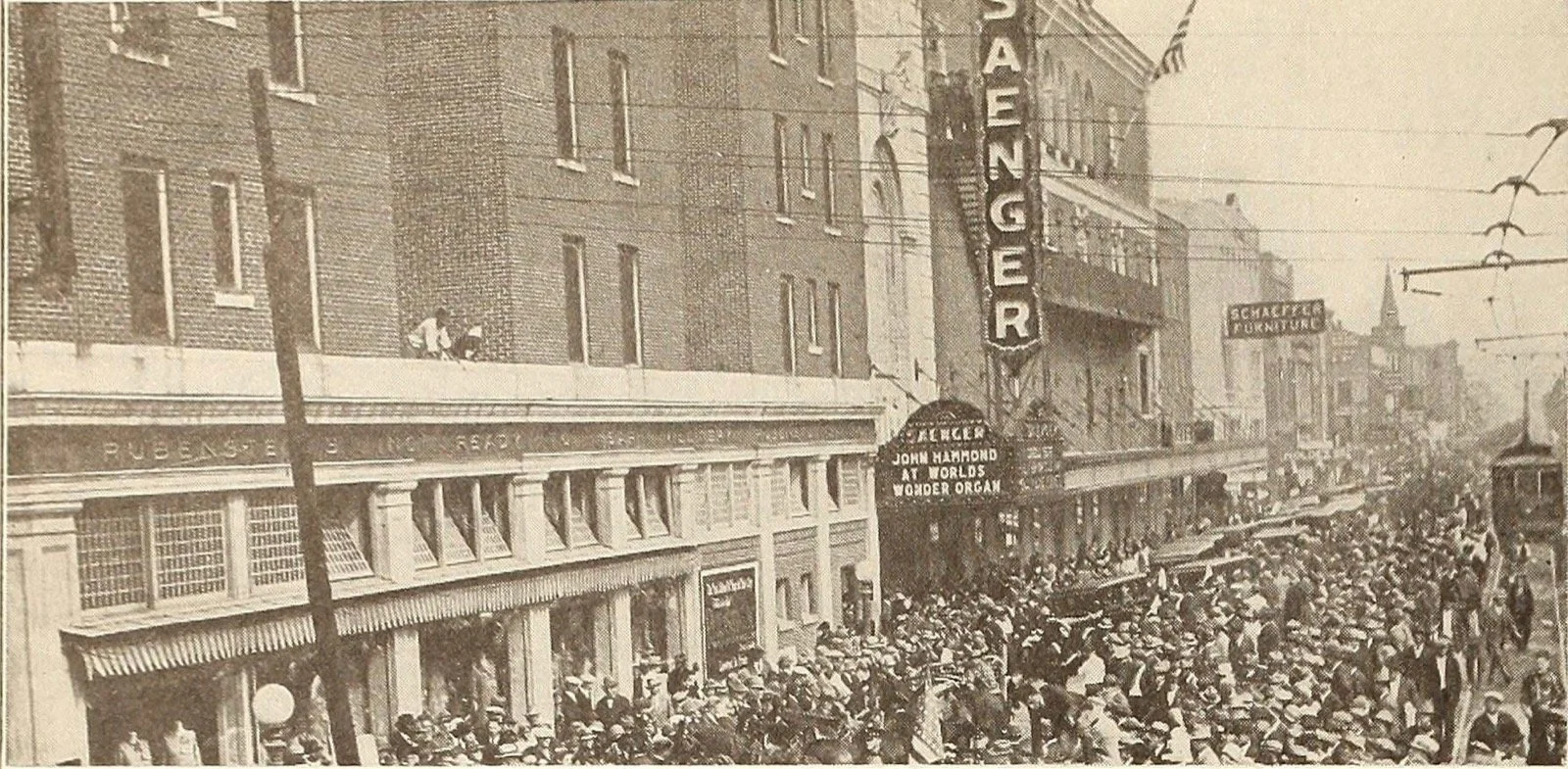
Crowds outside the Saenger Theatre in New Orleans in an early photograph from a film-trade publication.
Wikipedia also says the neon marquees of the Saenger, the Loews State, the Orpheum and the Joy once lit the sidewalks nightly, and that Canal Street was also home to early movie houses. One page says Vitascope Hall on Canal, opened in 1896, is said to have been the world's first for-profit movie theater. It is a claim the article itself hedges, so call it a local claim and not settled history.
For this season's lineup at two of these houses, see our guide to holiday concerts at the Orpheum and the Saenger. Our look at the Orpheum Theater tells the building's story in more detail.
When did Canal Street become an entertainment street?
Canal Street was staging shows long before the Saenger. Wikipedia says the Varieties Theater opened on Canal in 1871, between Dauphine and Burgundy streets, and was renamed the Grand Opera House in 1881. By the 1910s the Alamo, Plaza and Dreamworld movie houses were on the street, and the Trianon opened in 1912 as the city's first movie palace, followed by the Tudor in 1914 and the Globe in 1918.
Those smaller houses declined by the 1950s, and the article says most of them closed in the 1960s. The larger theaters near Rampart Street outlasted them. That history is why the street still feels like a theater district: the audience habit was set more than a century ago, and the restored marquees pick up where the old ones left off.
How does the Canal streetcar fit into the street?
The Canal Streetcar Line is the moving thread through all of this. The first horse-drawn cars ran on Canal Street in 1861, according to Wikipedia, and electric service began on July 28, 1894. The line was replaced by buses in 1964, and the last day of streetcar service was May 30 of that year.
The current streetcar line reopened April 18, 2004, nearly 40 years later. It has two branches: one runs the length of Canal Street to the cemeteries, and one turns toward City Park. Both run on tracks in the neutral ground.
The cars have changed color over the years. The article says the branches were red and light green until May 2024, then changed to light yellow and red. Check the regional transit authority's current map before you ride, because routes and schedules change.
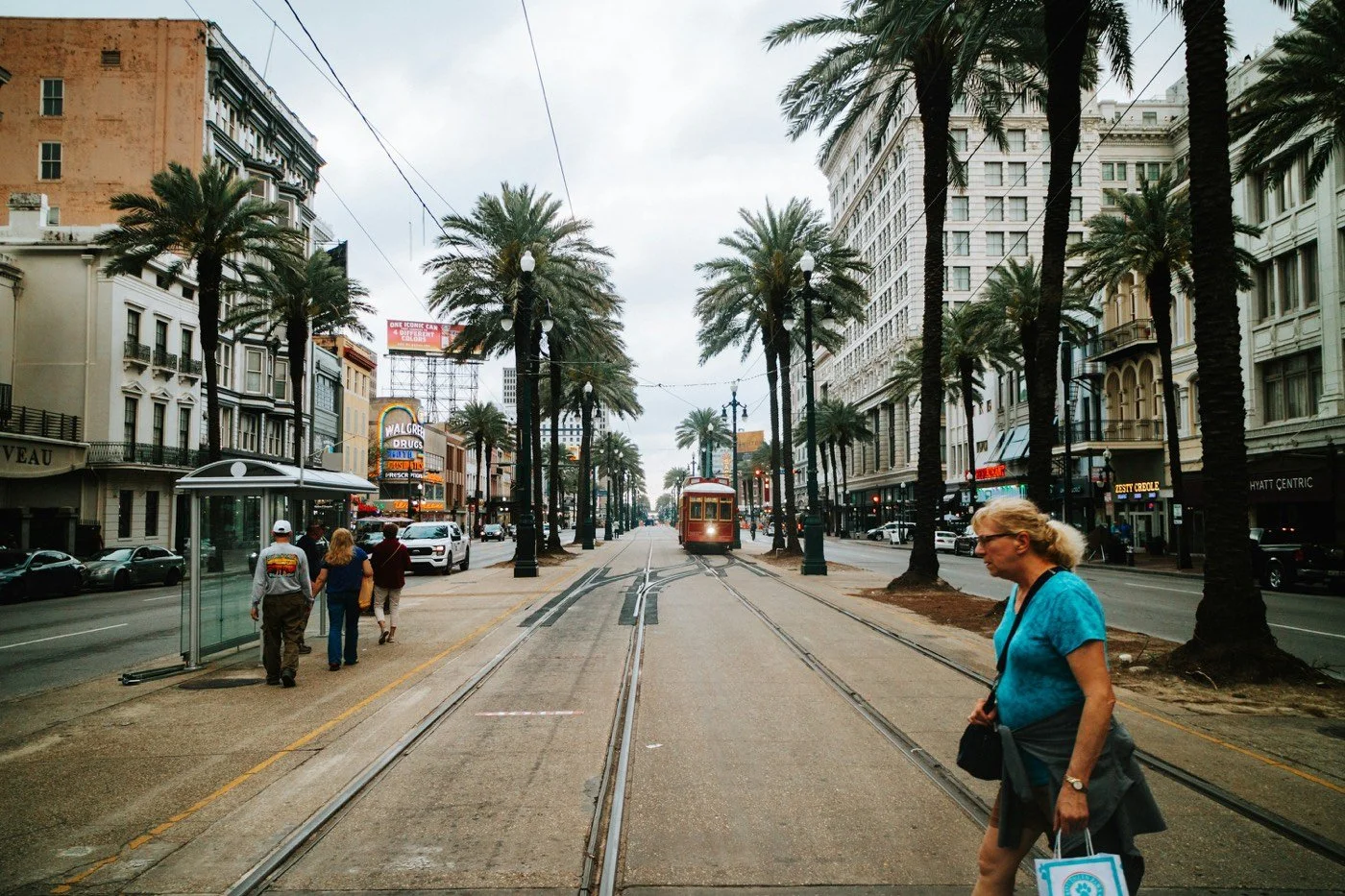
Streetcar tracks run down the center of Canal Street between rows of palm trees. Photo: Dhruvin Pandya.
What can you do on a day along Canal Street?
Start at the river end, where the Canal Street ferry terminal sits. Wikipedia says a new terminal opened in August 2023 and that passenger service to Algiers Point has run since 1827. Then follow the street toward the theaters.
A simple day might look like this:
- Morning: walk the French Quarter edge of the street and look up at the converted department store buildings.
- Midday: ride the streetcar for a stretch to see the neutral ground from the inside.
- Afternoon: photograph the marquees at the Saenger and the Joy.
- Evening: book a show at one of the theaters and keep the night unhurried.
If you would like a drink with some history to it, our story of the Hurricane cocktail's origins fits an evening in the Quarter, two blocks from Bourbon Street.
Plan Your Visit
- Where: Canal Street runs from the Mississippi River to the cemeteries near City Park. The French Quarter is on the river-side edge of the street.
- Getting around: the Canal streetcar travels in the neutral ground. Check the transit authority's site for current routes and fares.
- Theaters: confirm programs on each venue's own site. Dates and showtimes change.
- Footwear: the street is long and flat, and comfortable shoes help.
- Evenings: the marquees look best after dark.
- More ideas: our guide to things to do in New Orleans covers the rest of your trip.
Frequently Asked Questions
How long is Canal Street? About 3.6 miles, from the river to the cemeteries near City Park Avenue, according to Wikipedia.
Is Canal Street in the French Quarter? No. It is the upriver boundary of the French Quarter and the divide between the Quarter and the Central Business District.
Does the streetcar still run on Canal Street? Yes. The current Canal Streetcar Line reopened in 2004 after being replaced by buses in 1964.
Which theaters are on Canal Street? The Saenger Theatre and the Joy Theater are on Canal Street, and the Orpheum is a short walk away.
What is the neutral ground? It is the median down the center of a street. On Canal Street it holds the streetcar tracks.
A Hotel on the Street's Own Corner
Canal Street rewards slow days: a streetcar ride, a marquee at dusk, a long supper and an easy walk home. At Hotel Maison Pierre Lafitte, the corner of Roosevelt Way and Canal Street puts you inside the district this guide describes, two blocks from Bourbon Street and a short stroll from the Orpheum. Our rooms are a quiet place to land.
When you are ready to turn the history into a trip, the street is waiting. If you would like to plan a stay, Book your stay at Hotel Maison Pierre Lafitte.